Introduction
In today’s competitive manufacturing environment, organizations must strive for excellence in quality, productivity, and efficiency while reducing waste. One proven methodology that drives such transformation is Kaizen. Originating from Japan, Kaizen means continuous improvement and emphasizes small, incremental changes that collectively bring significant results.
This paper outlines the concept of Kaizen, its benefits, and a structured framework for its implementation in manufacturing industries.
What is Kaizen?
It is not just a tool; it is a philosophy and culture. The core principle is that every employee—from top management to shop-floor operators—should actively participate in identifying and implementing improvements in processes, systems, and work culture.
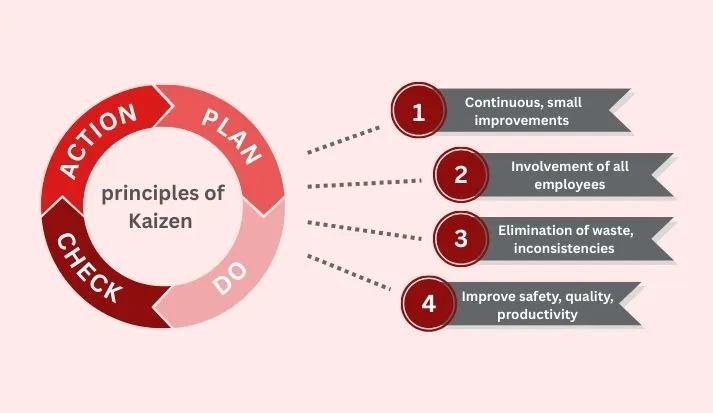
Key principles of this methodology include:
- Continuous, small improvements rather than sudden big changes.
- Involvement of all employees.
- Elimination of waste (Muda), inconsistencies (Mura), and overburden (Muri).
- Enhancing safety, quality, productivity, and employee morale.
Framework for Kaizen Implementation
Implementing this philosophy requires a structured roadmap. Below is a step-by-step framework:
1: Leadership Commitment & Awareness
- Conduct awareness sessions for management and employees.
- Define organizational goals aligned with Kaizen principles.
- Build a Kaizen promotion team.
2: Baseline Assessment
- Perform a diagnostic study to identify gaps in processes, productivity, and quality.
- Benchmark current performance using KPIs.
3: Training & Capacity Building
- Train employees in Kaizen tools and techniques (5S, PDCA cycle, root cause analysis, visual management, etc.).
- Develop problem-solving and idea-generation capabilities at all levels.
4: Identification of Improvement Areas
- Engage employees to identify pain points in processes.
- Use Gemba walks (shop-floor observation) to discover inefficiencies.
5: Kaizen Event Execution
Run structured Kaizen events (small focused projects).
Apply tools such as:
- 5S workplace organization
- Standardized work
- SMED (Single Minute Exchange of Die)
- Poka-Yoke (error-proofing)
- Value Stream Mapping (VSM)
6: Implementation & Monitoring
- Implement selected solutions in a pilot area.
- Track improvements using visual boards and performance metrics.
- Encourage quick wins to motivate teams.
7: Standardization & Documentation
- Document new methods and standardize best practices.
- Update work instructions and SOPs.
8: Continuous Improvement & Review
- Establish regular review meetings.
- Use PDCA (Plan–Do–Check–Act) for continuous improvement.
- Recognize and reward contributions.
Tools Supporting Kaizen Implementation
- 5S (Sort, set in order, Shine, Standardize, Sustain)
- Root Cause Analysis (5 Whys, Fishbone Diagram)
- Standard Work
- Visual Factory Management
- Kanban and Pull Systems
- Total Productive Maintenance (TPM)