What is TPM?
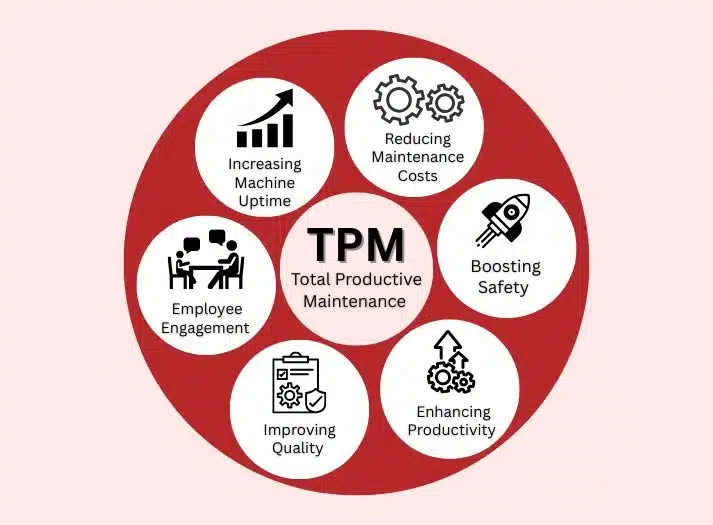
Total Productive Maintenance (TPM) is a world-class approach to improve equipment efficiency and reliability. It focuses on involving every employee – from operators to top management – in maintaining machines, reducing downtime, and achieving zero breakdowns, zero defects, and zero accidents.
For MSMEs, TPM is a game-changer: it not only improves machine uptime and productivity but also helps build a culture of ownership and continuous improvement.
TPM Implementation Framework for MSMEs
We follow a systematic TPM implementation roadmap designed for MSMEs:
Step 1: Management Commitment & Awareness
- Build understanding of TPM principles across leadership and workforce.
- Form a TPM steering committee.
Step 2: Baseline Assessment
- Evaluate current machine downtime, breakdown frequency, and maintenance practices.
- Identify critical equipment for TPM rollout.
Step 3: Training on TPM Pillars
- Train employees in the 8 TPM Pillars:
- Autonomous Maintenance (Jishu Hozen) – Operators maintain their own machines.
- Planned Maintenance – Preventive schedules to avoid breakdowns.
- Focused Improvement (Kobetsu Kaizen) – Eliminate chronic losses.
- Quality Maintenance – Prevent defects at the source.
- Early Equipment Management – Build reliability in new machines.
- Training & Development – Skill upgradation for operators and maintainers.
- Safety, Health & Environment – Ensure zero accidents.
- Office TPM – Improve efficiency in support functions.
Step 4: Pilot Implementation
- Select one machine/area for pilot TPM activities.
- Apply 5S, Autonomous Maintenance, and Planned Maintenance.
- Track improvements in downtime and OEE (Overall Equipment Effectiveness).
Step 5: Scale-Up
- Gradually expand TPM across all machines and departments.
- Standardize maintenance practices.
Step 6: Sustain & Continuous Improvement
- Conduct periodic audits and reviews.
- Recognize and reward employee contributions.
- Integrate TPM with Lean and Kaizen initiatives.
Key Benefits of TPM for MSMEs
- 10–30% Increase in Equipment Availability
- Reduction in Unplanned Downtime & Breakdowns
- Improved OEE (Overall Equipment Effectiveness)
- Enhanced Product Quality, Lower Defects
- Reduced Maintenance Cost & Spares Consumption
- Safer, More Productive Workplace
- Skilled and Responsible Workforce
Conclusion
TPM is not just a maintenance strategy – it is a business growth enabler for MSMEs. By training employees in TPM pillars and creating a culture of ownership, companies can achieve higher productivity, lower costs, and sustainable competitiveness. With our structured TPM implementation framework, we help MSMEs unlock hidden potential in their machines and people – driving them towards Operational Excellence.